- Well replenishment, pump delivery and usable stored water are different constraints with different units and test conditions.
- Nominal pressure-tank volume is not the released water between pump cycles or water guaranteed available when an outage starts.
- A buyer brief should document the actual source/components, quantity evidence, intended demand and professional unknowns; quality and emergency arrangements keep their separate evidence.
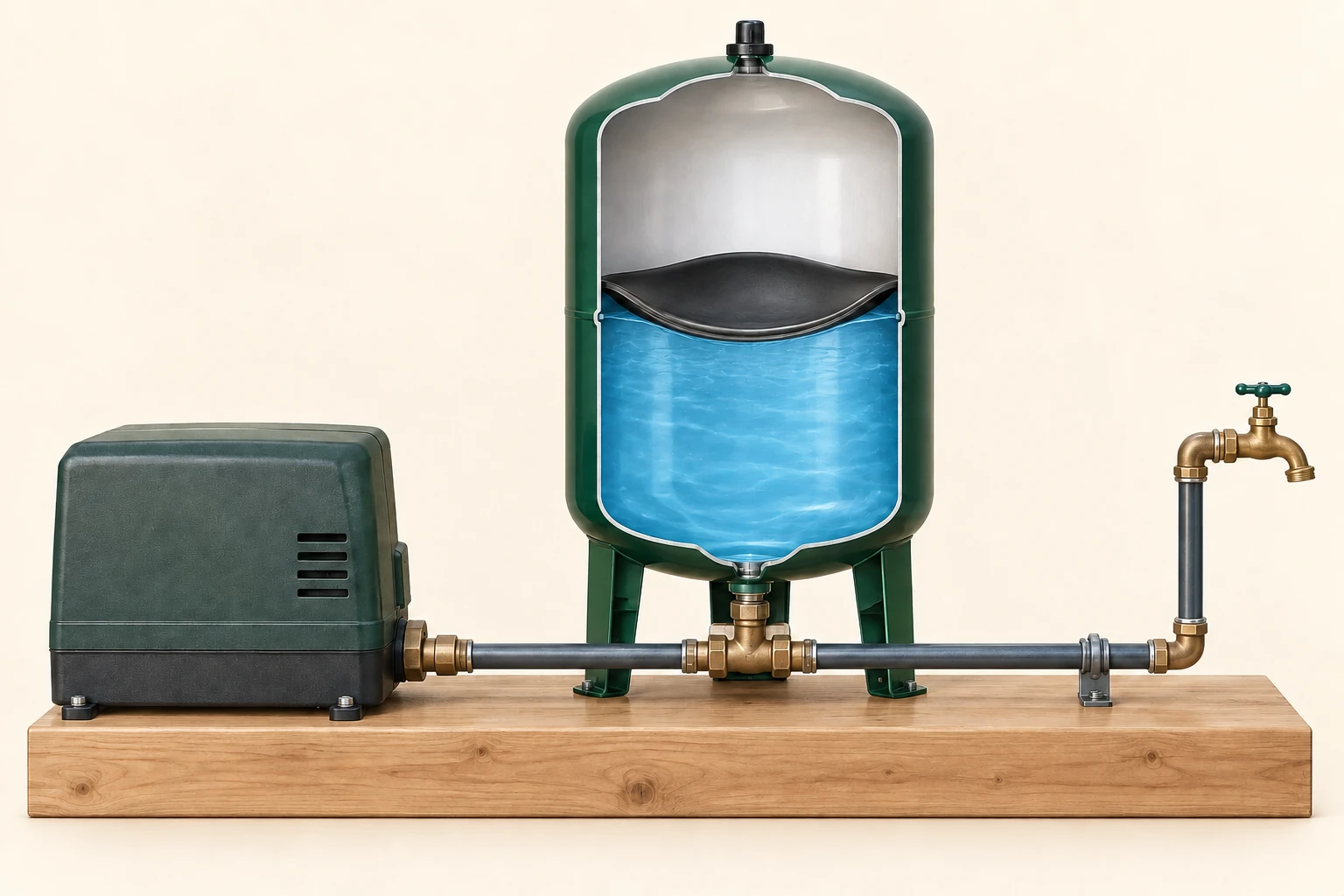
The curved diaphragm separates the visually empty upper air chamber from blue water touching its underside. A bottom branch connects drawn left and right pipe routes. A closed left enclosure and a right-hand tap are visible; the tap has no flowing stream.
About this illustration
This single conceptual position establishes no tank model, shell capacity, actual drawdown, pressure setting, air precharge, well replenishment, pump performance, bulk storage, outage duration or water-quality result. Drawn proportions cannot be converted to litres. The left enclosure has no established equipment identity. This is not permission to operate a private-well system during an outage. This is a conceptual teaching model, not an assessment of your home.
3 picture lessons appear beside the questions in this guide. Use them to understand the explanation, then consider what it means for your home.
Which water source and delivery chain serve this home?
A rural address can use a well, shared supply, delivered-water cistern or another documented arrangement. Start with the source actually serving the home, then identify the equipment between that source and the intended outlets. A system may include a well pump, controls, pressure tank, separate storage, onward pump and treatment in a property-specific order. Do not insert every component into a diagram merely because it is common in another house.
Request the source identity, available construction/service records and the provider’s confirmed component map. Mark a reported shared arrangement separately from the documents establishing access and permitted use. The private-well buyer guide retains water-quality panels and sample context; this lesson develops the quantity/delivery question. Clean appearance, a laboratory result or an unfamiliar tank in the mechanical room cannot fill a missing row in the supply map.
A well, delivery equipment and wastewater system have separate evidence.
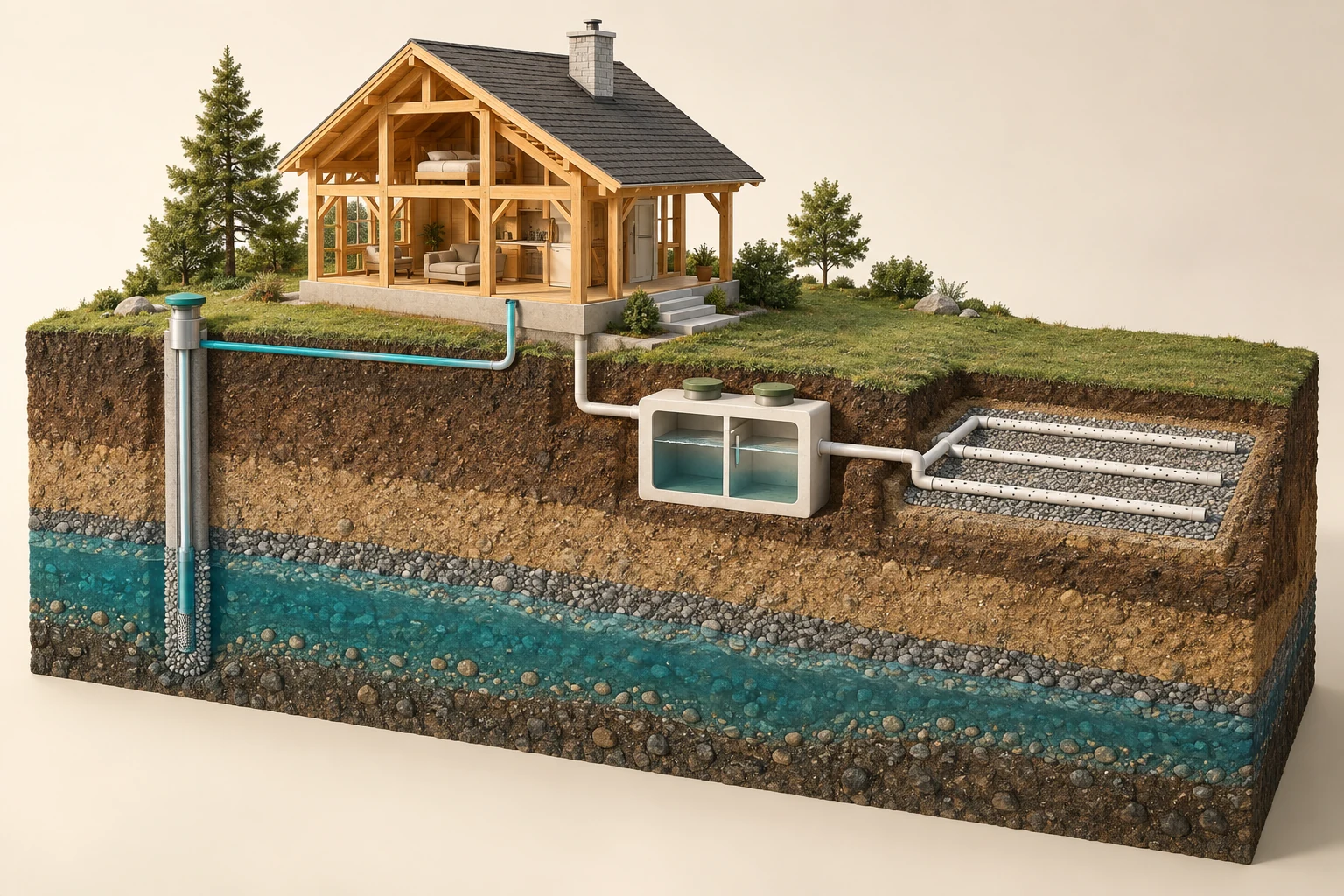
The scene distinguishes a water source from a wastewater route and its land context.
Numbers identify the parts explained below.
- Illustrated well location
The left-hand well form identifies a source question. It is not a located, opened or tested well, and it supplies no replenishment or water-quality result.
- House context
Identify the actual delivery equipment and intended household uses. The house model supplies no pump performance or demand record.
- Separate wastewater area
A separate buried wastewater arrangement is illustrated. Water delivery and wastewater capacity or power dependencies need their own scoped records.
What does this illustration leave out?
Actual locations, isolation, capacity, setbacks, groundwater and sample results are not supplied. This illustration explains an idea. It is not an installation guide.
Which actual water source, delivery equipment, separate storage and wastewater arrangements serve this property, and what intended uses and source records define the review?
Explore this with HomeAI ↗Opens an editable question. Nothing is sent until you choose to send it.How are rate, volume and demand different?
A rate describes water moving over time, such as litres per minute with the time unit attached. A volume describes an amount, such as litres. Simultaneous uses create a delivery question at that moment; repeated uses create a volume question over the documented period. A household can have modest daily consumption and a short busy period, or less simultaneous use with a substantial total. Describe both patterns rather than choosing one generic flow target for every rural home.
The source, pump, piping and storage may each answer a different part of that question. A pump’s listed delivery at specified conditions is not a measurement of water replenishing the well. A tank’s volume is not a continuing rate. Ask the professional which records connect the intended demand to each link and which time period they address. Keep units on every copied number; litres per minute, gallons per minute and litres stored are not interchangeable labels.
What does a well quantity report actually establish?
Read the method, date, pumping rate and duration alongside the water-level and recovery record. Well water-level drawdown is a change in level during pumping, expressed as a length with its measurement reference. Recovery describes what happens to that level after pumping stops. Water already stored within a well can also contribute during a test, so a brief observed output need not establish continuing replenishment under another use pattern.
Ontario’s yield-test chapter separates its construction-test purpose from testing aquifer characteristics. BC’s pumping-test resources discuss controlled conditions and professional design and interpretation for their own questions. Those provincial contexts should not be blended into one Canadian test requirement. Ask the qualified reviewer what this particular report supports for the intended use, which seasonal or changed conditions remain, and whether any defined further assessment is appropriate. A historical rate is useful evidence with a date and scope, not a permanent yield guarantee.
Why can a quick tap demonstration answer too little?
Water flowing during a showing establishes delivery at that outlet during that observation. It can be supplied while a pump runs, from pressurised water already available, or through another documented arrangement. It does not identify which link supplied that short interval or whether the source can meet a different duration and combination of uses. Nor does pressure noticed at a tap isolate the pump, aquifer, restriction or control as the cause of a later complaint.
Pump delivery also depends on the duty being assessed. Raising water and moving it through the installed pipes requires pressure; elevation and flow-related losses are part of the professional’s system question. A listed pump rate without its conditions is therefore incomplete evidence. The BC test-planning guide identifies pump selection and total dynamic head as separate considerations. This page explains why the condition matters, without deriving a pump size or prescribed operating point.
Ask for the actual pump/control identity and a professional delivery assessment where needed. Keep the original findings and units instead of summarising everything as good pressure. Do not run taps aggressively, empty storage, operate unfamiliar valves or deliberately interrupt power to create an informal stress test. The responsible professional should specify the authorised methods, equipment and limits. A brief showing observation should remain brief in the buyer record.
Why is the pressure tank not full of usable water?
In the diaphragm-tank example explained by Amtrol’s MC10185 (07/25) manual, incoming pumped water compresses air on the other side of a separating diaphragm. As water is withdrawn, pressure falls; the documented control arrangement calls for the pump to run again. The pressure tank therefore contains air and some water in a changing state. Pressure-tank drawdown means the released water between the defined pump-cycle conditions, not the tank’s total internal volume.
For a source-reading exercise only, Amtrol’s MC10188 (08/25) brochure lists its WX-202 with tank volume 20.0 gallons and system drawdown 5.4 gallons in the 40/60 pressure column; the companion pressure-band table labels these bands PSIG. The selected page says gallons without spelling out the gallon convention, so no Imperial or litre equivalent is asserted here. Its note also qualifies drawdown by ambient/system conditions. This is one manufacturer row, not an installed finding, product recommendation or instruction to set a control.
For the actual property, obtain the matching model/manual and the provider’s documented operating conditions. Available water at the instant power fails depends on the actual system state and usable delivery limits; neither the nominal volume nor that catalogue drawdown proves it. Keep well drawdown, measured as a water-level change, separate from pressure-tank drawdown, measured as a released volume. Never add air, adjust precharge, change pressure controls or open the tank to verify the lesson.
Tank shell volume and finite drawdown are different quantities.
The curved diaphragm separates the visually empty upper air chamber from blue water touching its underside. A bottom branch connects drawn left and right pipe routes. A closed left enclosure and a right-hand tap are visible; the tap has no flowing stream.
Numbers identify the parts explained below.
- Upper air chamber
The air region occupies part of the conceptual shell. Its drawn size supplies no actual precharge, pressure setting or capacity.
- Curved diaphragm
The visible separator touches the water below. One drawn position does not show the operating pressure interval or usable drawdown.
- Lower water chamber
Water occupies only the pictured lower region. Actual tank capacity and drawdown must retain their distinct units and manufacturer conditions; this drawing supplies no litre value.
What does this illustration leave out?
This single conceptual position establishes no tank model, shell capacity, actual drawdown, pressure setting, air precharge, well replenishment, pump performance, bulk storage, outage duration or water-quality result. Drawn proportions cannot be converted to litres. The left enclosure has no established equipment identity. This is not permission to operate a private-well system during an outage. This illustration explains an idea. It is not an installation guide.
Which actual tank model, stated shell capacity and condition-specific drawdown records apply, and is any separate bulk storage documented?
Explore this with HomeAI ↗Opens an editable question. Nothing is sent until you choose to send it.The same shell contains air and water.
Compare two conceptual diaphragm states. A pressure tank stores energy in compressed air and releases some water under stated conditions; its whole internal volume is not usable water.
Animation is paused. The complete lesson is available in the still diagrams and text.
Symbolic marks show the direction described in the selected still diagram. They do not show a flow rate, pressure, cycle duration, usable quantity or safe operation. Do not adjust air pressure, operate equipment or stage a tap test to reproduce the illustration.
Keep the separate well quality and buyer questions together ↗What changes if separate bulk storage is present?
A documented cistern or bulk-water tank is another storage component, not another name for the diaphragm pressure tank. Ask what fills it, how refill is controlled or arranged, and how water reaches the house afterward. Its gross capacity, current content and usable supply are separate records. Some nominal space or water may fall outside the system’s documented usable range; a label alone does not quantify that range.
Agriculture and Agri-Food Canada’s historical drought page illustrates a separate cistern with an onward pump; its farm-scale quantities and operating advice are not adopted here. Have the responsible provider identify the actual usable-volume evidence, level information, onward pump/control and service history. Do not enter a tank, remove covers or infer drinking-water suitability from an illustrated reservoir. Storage can coordinate supply and demand while retaining refill, power and quality dependencies. It does not create replenishment or prove that every tap continues to work during an outage.
Which intended uses belong in the buyer brief?
Write the intended household pattern in plain language: year-round or seasonal occupancy, expected occupied areas, simultaneous household activities and additional proposed uses. Tell the professional about a proposed additional dwelling, garden demand or other significant change instead of assuming the current seller’s routine represents yours. Ask which evidence addresses ordinary peaks, total use and the relevant seasons. No flow or daily-volume number in this lesson is a national minimum or an acceptance test.
Keep feasibility and permissions as separate questions. The authority and appropriate advisers should explain applicable water-use, shared-service and property arrangements for the location. A technical supply report does not approve an additional unit or establish a right to use a neighbouring source. Intended water use can also raise an independent wastewater design question, retained in the septic guide. Do not translate a sufficient-looking supply figure into approval of the entire future development.
Which powered link matters when electricity is unavailable?
Identify the actual pumps, controls and any treatment dependencies in the supplied records. A well containing water does not establish that its electrically powered delivery continues. A pressure tank may initially release some water while pressure declines, but this guide gives no guaranteed amount or duration. A bulk store can retain water while its onward powered pump cannot deliver it. These are distinct links to ask the installer and well provider about.
This mechanism is not permission to draw stored well water during an outage. Health Canada advises private-well households against opening taps, showering or flushing toilets while power is out: drawing stored water reduces pressure and increases contamination risk. Keep emergency alternatives and restoration decisions with the power-outage guide and the applicable public-health/well professionals. This warning concerns private wells rather than every Canadian water supply.
If a backup arrangement is supplied, compare its installed protected-load record with the named equipment and exclusions. Do not infer pump starting/running compatibility or runtime from a cabinet labelled whole home. The backup-battery guide retains that electrical evidence question, while the power-outage guide retains safe alternatives, emergency planning and restoration. No generator connection, battery sizing, pressure adjustment or staged power failure is part of this buyer lesson. Water-quality requirements remain separate when power or pressure returns.
Finite pressurised water is not an outage-use instruction.
The curved diaphragm separates the visually empty upper air chamber from blue water touching its underside. A bottom branch connects drawn left and right pipe routes. A closed left enclosure and a right-hand tap are visible; the tap has no flowing stream.
Numbers identify the parts explained below.
- Closed left enclosure
This enclosure has no established equipment identity. Identify the actual powered delivery link and its operating instructions from the property records.
- Bottom pipe branch
The branch relates the drawn routes. It does not demonstrate pump operation, available outage supply or a safe restart procedure.
- Right-hand tap
No flow is shown. Health Canada advises private-well users not to open faucets, shower or flush toilets during an outage because pressure loss can increase contamination risk. Use the detailed outage companion and actual system instructions.
What does this illustration leave out?
This single conceptual position establishes no tank model, shell capacity, actual drawdown, pressure setting, air precharge, well replenishment, pump performance, bulk storage, outage duration or water-quality result. Drawn proportions cannot be converted to litres. The left enclosure has no established equipment identity. This is not permission to operate a private-well system during an outage. This illustration explains an idea. It is not an installation guide.
Which powered links and actual system instructions apply to this private well, and how does the household outage plan preserve the pressure-loss precaution without treating tank drawdown as available emergency supply?
Explore this with HomeAI ↗Opens an editable question. Nothing is sent until you choose to send it.What should a scoped professional quantity review deliver?
Give the reviewer one table linking source identity, quantity-report dates/conditions, installed pump/control, pressure tank and any separate storage to the intended demand. Use unknown where a model, unit, test condition or component relationship is unresolved. Ask which existing evidence can be interpreted now, which further task would answer a consequential gap and what access, permissions and turnaround it requires. A specialised question may need a well professional and hydrogeological expertise rather than an expanded general home-inspection promise.
Request a written conclusion with its method, conditions, limitations and intended-use scope. Preserve the original numbers and distinguish source behaviour, installed delivery and storage findings. Provincial resources illustrate why those methods and professional roles need local confirmation. The report should not imply future drought performance or a different occupancy that it did not examine. Transaction timing, lender/insurer reliance and any agreement remain matters for the relevant advisers; the quantity lesson does not select a purchase decision.
How would a fictional buyer read the mixed evidence?
Explicitly fictional property: a seller supplies a dated laboratory report, a short quantity note lacking duration/recovery context, an invoice naming a replacement pump, and a pressure-tank label. The buyer plans year-round use with a busier simultaneous-use pattern than the seller reports. A tap runs during the visit. These invented observations do not establish inadequate supply, a defective tank or a misstatement; they identify the evidence that is still missing.
The buyer keeps laboratory scope in the quality file, asks the provider to match the source and components, and requests interpretation of the quantity note against the intended demand. A tank brochure is read with its exact volume/drawdown columns and operating conditions, without converting its label into outage storage. If the eventual report addresses the tested season but retains uncertainty about another season or a proposed use, that limit remains in the handover. No actual water quality, sustainable yield, backup compatibility, permissions or outage duration is proved by this case.
Practice the distinction.
A fast tap and a large-looking tank leave different questions open
Explicitly fictional buyer and documents. A lab report, incomplete quantity note, replacement-pump invoice and tank label do not establish performance for a changed year-round use pattern.
Reported observations
- The quantity note lacks duration and recovery context.
- A pump invoice identifies changed equipment but no source replenishment finding.
- A pressure-tank label does not identify usable water at the start of an outage.
- The buyer’s proposed use differs from the seller’s reported pattern.
Compare the explanations
Expand each possibility to see the evidence needed to distinguish it. Similar symptoms can have different mechanisms.
Useful component and sample evidence with quantity gaps
The documents can establish narrower facts without supporting the whole intended supply pattern.
Matched source/test conditions and a qualified quantity/delivery/storage interpretation.
An operating or seasonal dependency remains
The actual chain may depend on powered delivery, refill or conditions outside the supplied record.
Model-matched operating records, tested-season limits and the installer’s actual protected-load findings.
A useful next question
Define intended use, reconcile the three quantity mechanisms with the qualified providers, and retain the separate quality and emergency files.
No universal supply target, pump/backup sizing, pressure adjustment, quality verdict, use permission or outage-runtime promise is represented.
Know what the words mean.
- Replenishment
- Water entering the well or documented storage from its source over time; separate from the rate the installed pump can deliver.
- Delivery rate
- Water supplied over a stated time under identified operating conditions, with the volume and time units retained.
- Well water-level drawdown
- The change in well water level during pumping, measured as a length relative to its reference; distinct from a tank’s released-water volume.
- Recovery record
- Water-level observations after the test pumping stops, interpreted with the actual test method and conditions.
- Pressure-tank drawdown
- Released water volume between the specified pump-cycle conditions in the described pressure-tank arrangement; not nominal tank volume or guaranteed outage water.
- Nominal tank volume
- The manufacturer’s labelled total tank-volume quantity; it is not a measurement of usable water currently available.
- Usable bulk storage
- Water available within the documented usable range of a separate storage component, with refill and onward-delivery dependencies retained.
- PSIG
- Pounds per square inch measured relative to atmospheric pressure; a pressure unit, not water volume or delivery rate.
Questions to bring
to the conversation.
- What source, sharing/access arrangement and delivery chain actually serve this property?
- Which quantity report matches that source, and what rate, duration, water levels, recovery and seasonal conditions does it document?
- Which pump/control and pressure-tank models are actually installed, with matching manuals?
- Are nominal tank volume, pressure-tank drawdown and well water-level drawdown kept as different quantities?
- Is separate bulk storage present, and what usable-volume, refill and onward-delivery evidence exists?
- What simultaneous, daily, seasonal and proposed uses were included in the professional assessment?
- Which powered links and documented backup connections affect delivery, without assuming an outage runtime?
- What quality, rights/approval or wastewater questions need their own qualified answer?
Separate a showing observation, an existing record and a new professional assessment. Unknown means a question remains; it does not automatically mean a defect.
Use the evidence planner ↗Go to the source.
Original HomeAI explanation informed by these public references. Sources support the underlying guidance; they have not reviewed or endorsed HomeAI. Diagrams are conceptual, and calculator outputs depend on your inputs.
Publication & source review
First published .
Sources reviewed .
- Ontario · Water supply wells: yield test
Where this reference applies
Jurisdiction: Ontario well-construction yield-test requirements and best-practice explanation; not a national transaction procedure
Publisher publication date: 2016-10-31
Publisher modification date: 2026-03-31
Purpose and limits of quantity evidence; pumping rate, stored well water, water-level change, recovery and changed conditions. Ontario construction yield testing is distinguished from aquifer-performance testing. No national minimum supply rate, mandated buyer test duration, test operating sequence, pump sizing or quantity guarantee.
- British Columbia · Pumping tests
Where this reference applies
Jurisdiction: British Columbia professional pumping-test and groundwater context; domestic/non-domestic obligations differ
Publisher modification date: 2026-08-17
Controlled pumping, water-level observations, test design and professional interpretation. This page does not establish a Canadian purchase requirement, permission for the intended water use, universal flow threshold or safe homeowner testing method.
- British Columbia · Guide to conducting well pumping tests
Where this reference applies
Jurisdiction: British Columbia hydrogeological test context; methods and regulatory classifications stay scoped
Edition: 10 PDF pages; no printed publication date established in the selected pages; bounded pages 1–3 and 7–8 read
Distinction between short yield observations and designed pumping/recovery questions, seasonal/test conditions and report limitations. Numerical testing criteria, apparatus, discharge arrangements and test procedures are excluded; BC methods are not combined with Ontario requirements into a national prescription.
- Agriculture and Agri-Food Canada · Water wells during drought
Where this reference applies
Jurisdiction: Historical federal farm-water explanation; not a household supply design, current provincial procedure or drinking-water finding
Publisher modification date: 2016-06-17
Only the separate cistern and onward-pump relationship in the What to do section supports the bulk-storage mechanism. Historical storage quantities, monitoring intervals, pumping adjustments, diagnostic shortcuts, chemical treatment and references to older organisations are excluded.
- Amtrol · Well-X-Trol installation and operation instructions
Where this reference applies
Jurisdiction: Manufacturer model-family explanation with US code references; not proof of Canadian approval or any installed tank identity
Edition: MC10185 (07/25), part 9015-868; ©2025; 6 PDF pages; bounded pages 1–2 and 6 read
Diaphragm-tank pump/air/water mechanism and drawdown between pump cycles. No pressure/precharge adjustment, wiring, installation, commissioning or pump selection instructions; stored water and pressure at an actual outage start are not established by the manual.
- Amtrol · Well-X-Trol model specifications
Where this reference applies
Jurisdiction: Manufacturer product-data example with US context; exact installed model and operating conditions must be established separately
Edition: MC10188 (08/25); ©2025; 8 PDF pages; bounded pages 6–8 read
Tank volume versus system drawdown and labelled pressure bands, including stated ambient/system-condition limits. One WX-202 row is used only as a reading exercise. The source labels volume in gallons without spelling out the gallon convention; no conversion, equipment recommendation, sizing table, treatment claim or outage-runtime forecast is supplied.
- Health Canada · Well safety during and after emergencies
Where this reference applies
Jurisdiction: Canada; private-well power-outage safety only, not a universal municipal-water instruction
Publisher publication date: 2024-08-02
Publisher modification date: 2024-08-02
Bounded Power outages passage: drawing stored private-well water while power is out depressurises the system and increases contamination risk; Health Canada advises against opening faucets, showering or flushing toilets. Numbered retained text lines 141–148 and current official HTML readback support the adjacent safe-use boundary. Detailed emergency alternatives and restoration remain with the existing outage guide and appropriate public-health/well professionals. No sampling, boiling, disinfection, flushing, pressure adjustment or pump restart procedure is adopted.
Have a question about your home?
Start with the symptom, timing and what you have observed.
Ask HomeAI