Jump to a question in this guide
- What does a ceiling fan change in the room?
- How do the motor, blades and room air work together?
- Why can the light work while the fan behaves differently?
- Does a direction label tell me what to change?
- Why is the support above the canopy a separate question?
- What should I do about wobble, noise or changed operation?
- What can comfort observations and product numbers establish?
- When does the household need a wider heat plan?
- Who should explain a replacement or installation proposal?
- Fictional example: does a working light clear a noisy fan?
- What should the fan handover and care file contain?
- Room-air movement differs from heat removal and outside-air ventilation.
- Motor, light, controls and supporting attachment have separate jobs.
- Ordinary comfort or a working light does not clear a fan concern or establish heat safety.
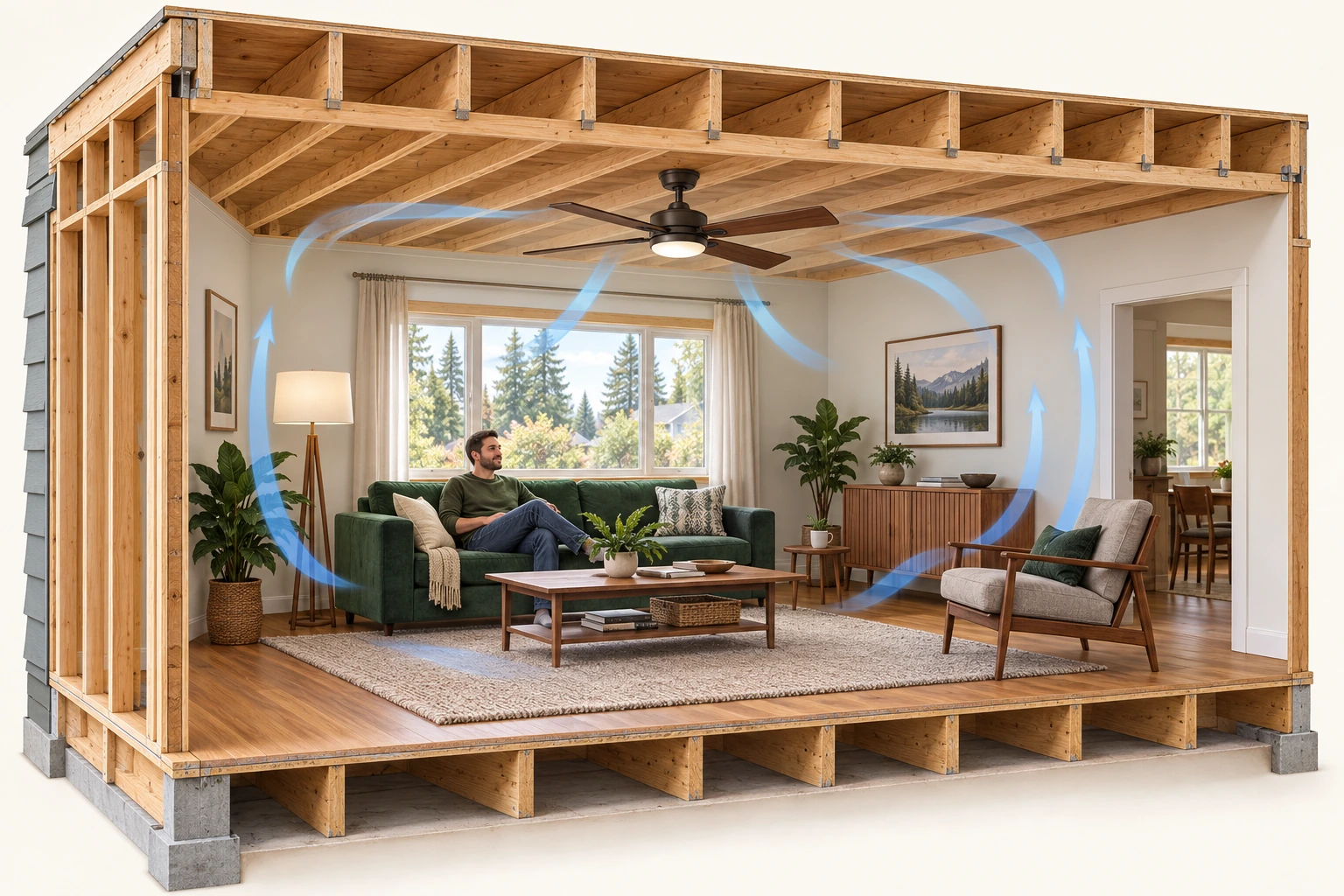
The fan moves room air around an occupied area. The blue arrows illustrate a conceptual circulation pattern rather than measured flow, cooling or outside-air supply. The native route figure separately explains the outdoor heat-removal job of cooling equipment.
About this illustration
No measured air speed, exact circulation pattern, assessed support, approved clearances, cooling capacity or heat-safety finding. This is a conceptual teaching model, not an assessment of your home.
6 picture lessons appear beside the questions in this guide. Use them to understand the explanation, then consider what it means for your home.
What does a ceiling fan change in the room?
A ceiling fan turns blades to move air within a room. That air movement can change how a person experiences the surroundings. It does not provide the outside heat-removal route of an air conditioner. A room can feel more comfortable in a breeze while its air temperature has not fallen. Start with the intended result: air movement at an occupied place, room cooling or outside-air ventilation.
Natural Resources Canada describes ceiling fans in terms of circulating air and occupant comfort. Hydro-Québec also discusses a ceiling fan as a companion to air conditioning. Those ideas connect two different jobs: cooling equipment removes heat through its designed route, while the ceiling fan moves room air. The fan does not become a replacement for a suitable heat-relief plan.
The whole-room cutaway locates an intact fan above a familiar occupied area. Its route diagram returns air to the same room rather than drawing an outside-air connection. That distinction matters when someone calls the fan ventilation. A visible breeze cannot establish fresh-air supply, exhaust, particle filtration or removal of a pollutant source.
This guide owns the fan’s motor, blades, ordinary controls, support questions and local comfort evidence. The overheating guide owns the room’s wider energy balance and heat plan; the forced-air guide owns HVAC supply and return routes; the lighting guide owns LED and dimmer pairing. Connected questions remain useful without treating one ceiling appliance as the whole heating, cooling, ventilation and electrical system.
The fan moves air around an occupied place
The fan moves room air around an occupied area. The blue arrows illustrate a conceptual circulation pattern rather than measured flow, cooling or outside-air supply. The native route figure separately explains the outdoor heat-removal job of cooling equipment.
Numbers identify the parts explained below.
- Intact fan
Motor-driven blades serve the air-moving job.
- Occupied place
The household experiences comfort here, which differs from a whole-room measurement.
- Room boundary
Recirculated room air is not automatically outdoor-air exchange.
What does this illustration leave out?
No measured air speed, exact circulation pattern, assessed support, approved clearances, cooling capacity or heat-safety finding. This illustration explains an idea. It is not an installation guide.
Is the intended result local air movement, room cooling or ventilation?
Explore this with HomeAI ↗Opens an editable question. Nothing is sent until you choose to send it.How do the motor, blades and room air work together?
The motor supplies rotation to the fan assembly. The blades move through air and create the intended air movement. The room and occupied location then determine where that movement is experienced. A turning blade is therefore one visible stage in a longer functional question: what ordinary setting is active, what moves, and where does the person actually notice the result?
Keep the movement and heat-removal jobs separate. Air recirculating around a person can affect comfort without carrying the room’s heat outdoors. The native figure keeps the fan’s room-air circulation separate from an outside heat-rejection route. It does not depict a fan duct, introduce outdoor air or measure a safe condition for an occupant.
Fan shape alone does not establish the result at a chair or bed. The actual model, arrangement and use need their own explanation. Ask the supplier or qualified provider what the product information describes and which occupied area the proposal is intended to serve. A showroom demonstration differs from the room in your home.
Do not hold tissue, ribbon, smoke or objects near moving blades to trace a route. Do not reach into the blade area or deliberately change furnishings to create an obstruction test. Existing ordinary observations can describe where a breeze was noticed. If the performance concern remains, the appropriate provider can identify which assessment is useful and what it excludes. A diagram teaches the causal jobs without becoming a homeowner experiment.
Air movement and heat removal have different routes
The fan circulates air within the room. An air conditioner has a distinct outside heat-rejection route; the fan breeze alone does not establish fresh-air supply or room cooling.
Numbers identify the parts explained below.
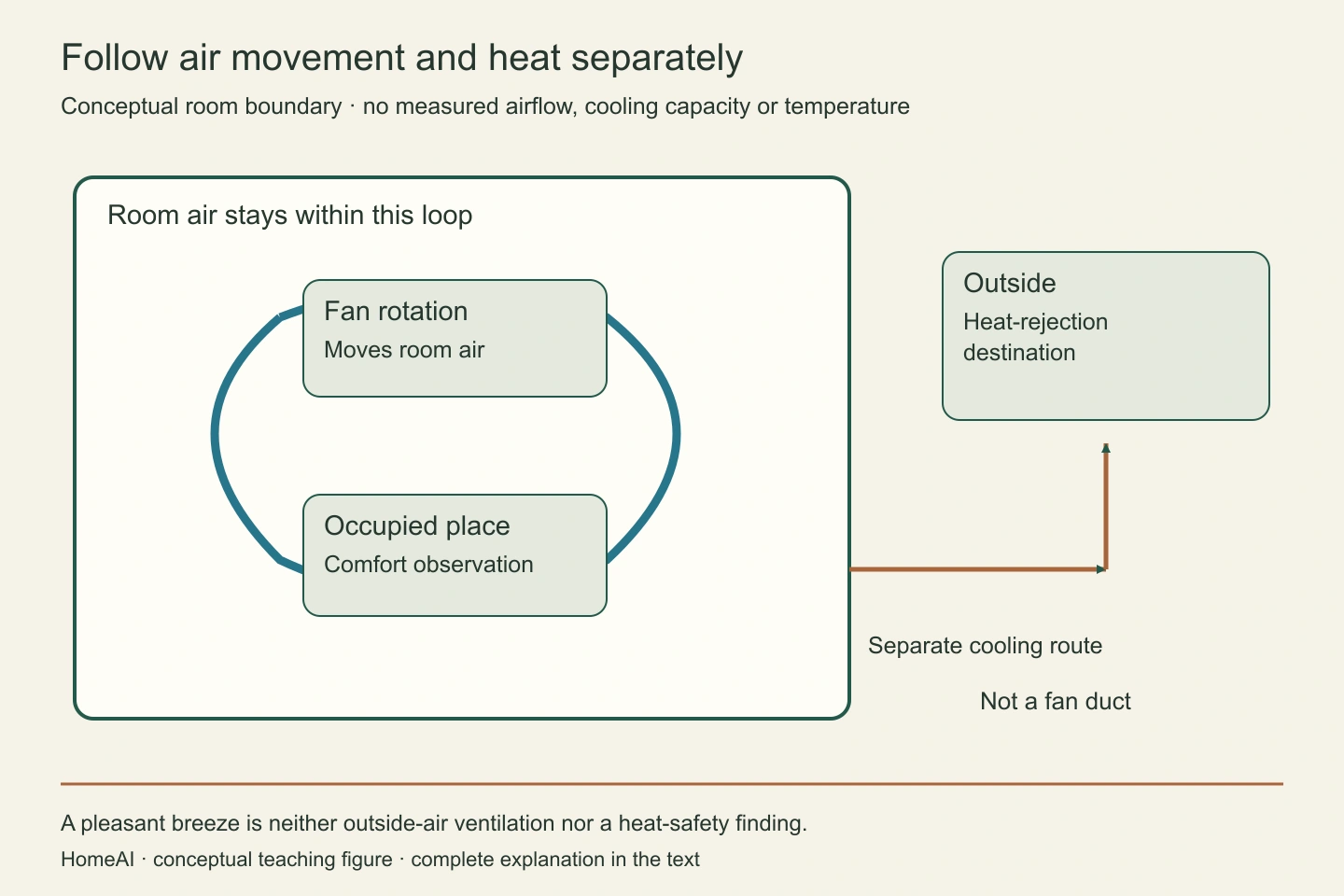
- Fan and motor
Rotation moves air within the conceptual room boundary.
- Occupied place
Comfort is experienced here; it is not a whole-room temperature measurement.
- Cooling equipment
A separate heat-removal arrangement rejects heat outside its cooled space.
What does this illustration leave out?
Conceptual learning figure; no property measurement, approved installation or owner test. This illustration explains an idea. It is not an installation guide.
Is the desired outcome local air movement, heat removal or outside-air exchange?
Explore this with HomeAI ↗Opens an editable question. Nothing is sent until you choose to send it.Why can the light work while the fan behaves differently?
A fan with lighting combines different useful functions in one visible appliance. The motor turns the blades; the light provides illumination; the controls request their intended states. A working light does not establish motor operation. Turning blades do not establish correct lighting control. The equipment documents should explain how these functions are intended to work in the actual model.
Canarm’s named CF-5E dual-mount manual provides one concrete example with separate light, speed and direction control functions and model-specific remote provisions. It is a multi-model document marked 11/23, hosted on a US manufacturer site with Canadian references. Its details are not a description of every ceiling fan or an approval of the fan in your room.
Ask for the exact fan, light and applicable control identities. If a remote is supplied, keep its instructions and documented relationship to the fan. If a wall device is present, have the provider explain its intended job. The presence of a slider or a familiar-looking remote does not prove that it is compatible with an unknown motor or light.
Leave electrical identification and compatibility work with the qualified provider. Do not replace a control, enter pairing procedures or remove the canopy to discover the arrangement. The lighting guide develops dimmer pairing separately. An ordinary off command is a user-control state, not an electrical isolation procedure or permission to access concealed parts.
Motor, blades, light and control have separate jobs
The closed motor housing, blades and light have distinct jobs: rotation, air movement and illumination. The separate remote represents ordinary requests; its symbols do not establish a compatible control or a wiring arrangement for an actual fan.
Numbers identify the parts explained below.
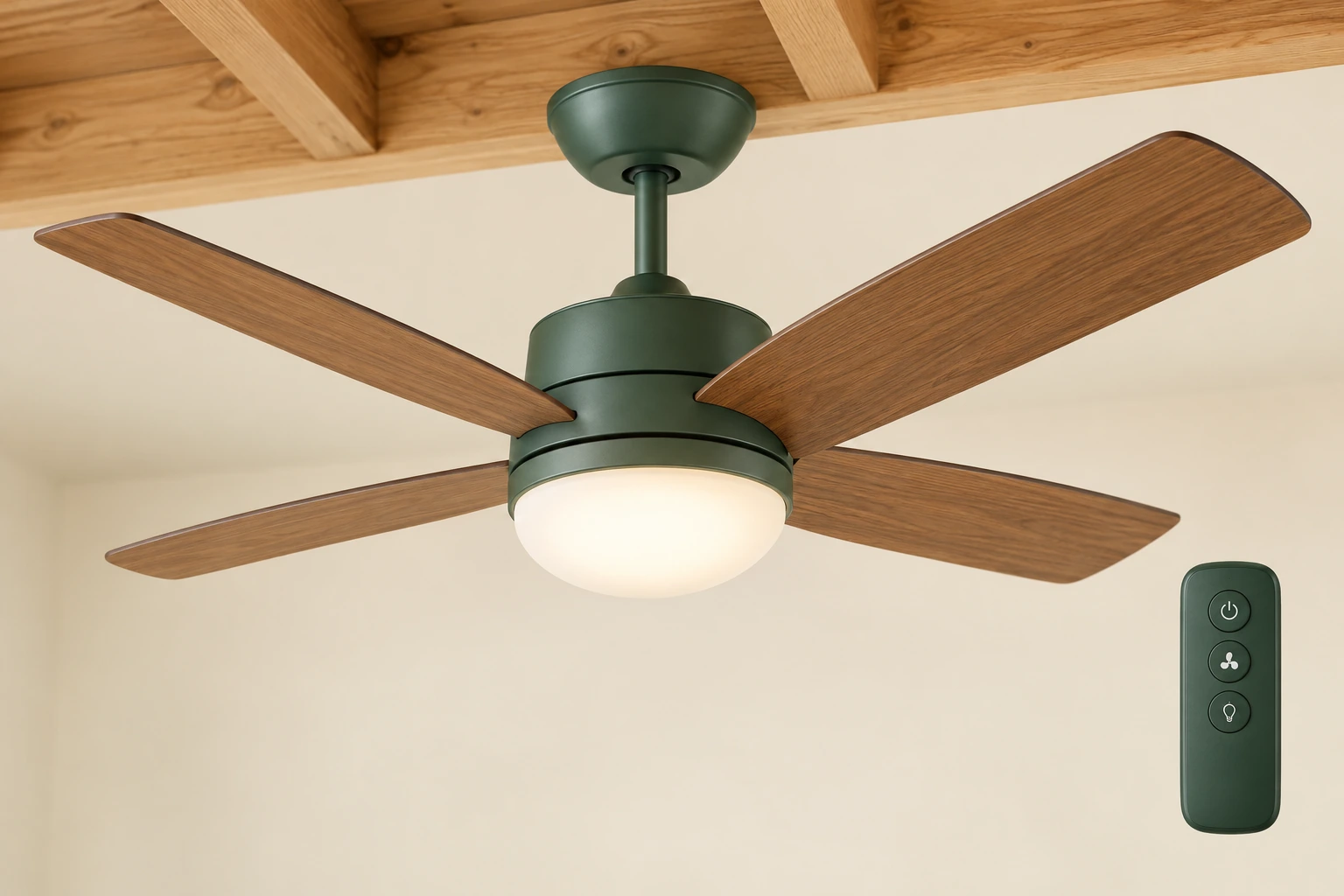
- Closed motor housing
Contains the part that provides rotation; its internal condition is not visible.
- Blades
Move air as the assembly turns.
- Light
Provides illumination as a separate function.
- Ordinary control
Requests documented functions; this generic remote does not establish compatibility.
What does this illustration leave out?
Generic component view; exact model, circuitry, approved control pair, hidden support and installation clearances remain unknown. This illustration explains an idea. It is not an installation guide.
Which exact fan and controls do the matching instructions identify?
Explore this with HomeAI ↗Opens an editable question. Nothing is sent until you choose to send it.Does a direction label tell me what to change?
Some fans offer different directions or operating modes. Their meaning and method belong to the actual model instructions. A general seasonal tip should not replace that information. The useful question is what the documented mode is intended to do in this room, rather than assuming that a clockwise label, viewing angle or switch location is identical across products.
The mode figure separates a documented control state, intended air movement and reported occupied-place comfort. It deliberately supplies no switch sequence or universal direction setting. Any permitted ordinary operation must follow the intact equipment’s actual instructions. Do not climb to a switch, reach toward blades or change a suspect device to complete the worksheet.
A fan can redistribute air already in the room without providing a separate space-heating function. If the household hopes to address a high-ceiling comfort difference, ask an HVAC or appropriate equipment professional how the proposed circulation relates to the room’s heating, controls and use. A broad winter-use description does not establish that the ceiling fan will resolve every cold area or reduce bills.
Record an already known setting with its source: manual, ordinary display or provider handover. Leave an unfamiliar switch unexplained until its instructions are confirmed. A quieter impression or different breeze after a change remains a dated observation. It is not proof of required airflow, a corrected electrical fault or an isolated energy saving. The provider should connect any recommendation to the actual intended outcome.
Controls request different functions
The actual model’s ordinary controls can request fan movement, lighting and a documented direction or mode. A working light does not prove motor operation or control compatibility.
Numbers identify the parts explained below.
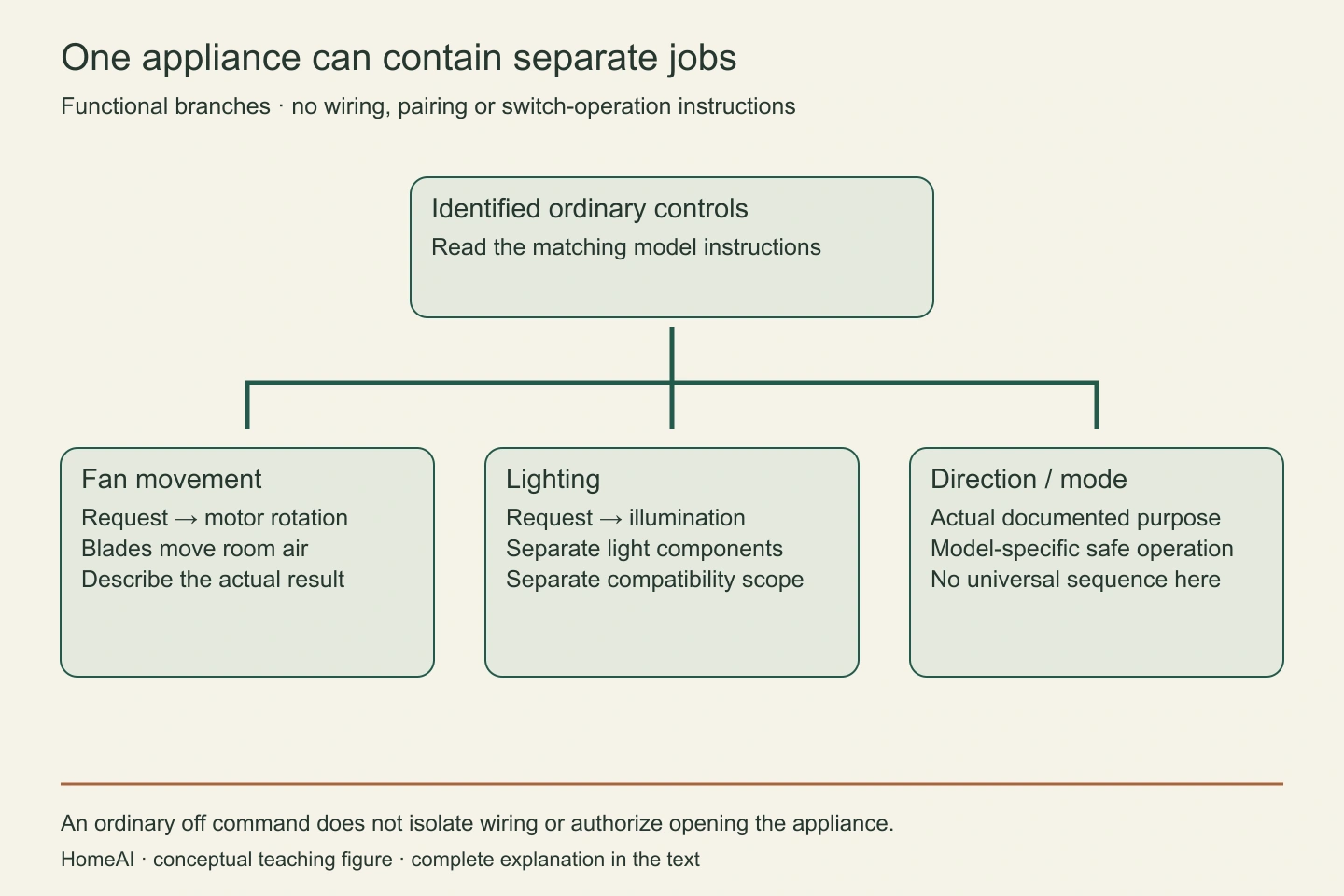
- Fan movement
Motor and blades perform the air-moving job.
- Lighting
The light provides illumination under its documented control arrangement.
- Documented mode
Its purpose and permitted operation come from the actual model instructions.
What does this illustration leave out?
Conceptual learning figure; no property measurement, approved installation or owner test. This illustration explains an idea. It is not an installation guide.
Which exact controls and instructions belong to this appliance?
Explore this with HomeAI ↗Opens an editable question. Nothing is sent until you choose to send it.Why is the support above the canopy a separate question?
The canopy is the visible cover near the ceiling. It is not, by its appearance, a complete description of the attachment holding the appliance. The suspension and supporting building arrangement carry a different responsibility from the motor’s air-moving job. An attractive finish, quiet operation or an earlier light at that location cannot establish suitability for a ceiling fan.
The named Canarm manual explicitly distinguishes acceptable fan support from ordinary lighting support and assigns suspension work to suitably qualified people. That manufacturer example explains why replacement is more than exchanging two decorative fixtures. The actual product, ceiling, support, clearance and electrical requirements must be assessed together for the address.
The component close-up keeps the canopy and motor closed. A separate native support map names fan, suspension, appropriate support and building structure as functional relationships, without showing fasteners or an approved assembly. Concealed details remain unknown. No viewer should use the figure to select a box, bracket, screw, rod or structural attachment.
Ask what the provider will identify, what access is required and which surrounding building elements are included. If the ceiling or support needs work, put that scope and restoration in the proposal. In a shared building, confirm authorization for affected common elements. An electrical appointment and a structural assessment can answer different questions; the provider should explain which responsibility applies rather than assuming one invoice covers everything.
The fan’s weight needs its own assessed support
The fan, suspension, appropriate support and building structure form a support relationship. The ceiling canopy covers parts of that relationship; its finish cannot establish concealed suitability.
Numbers identify the parts explained below.
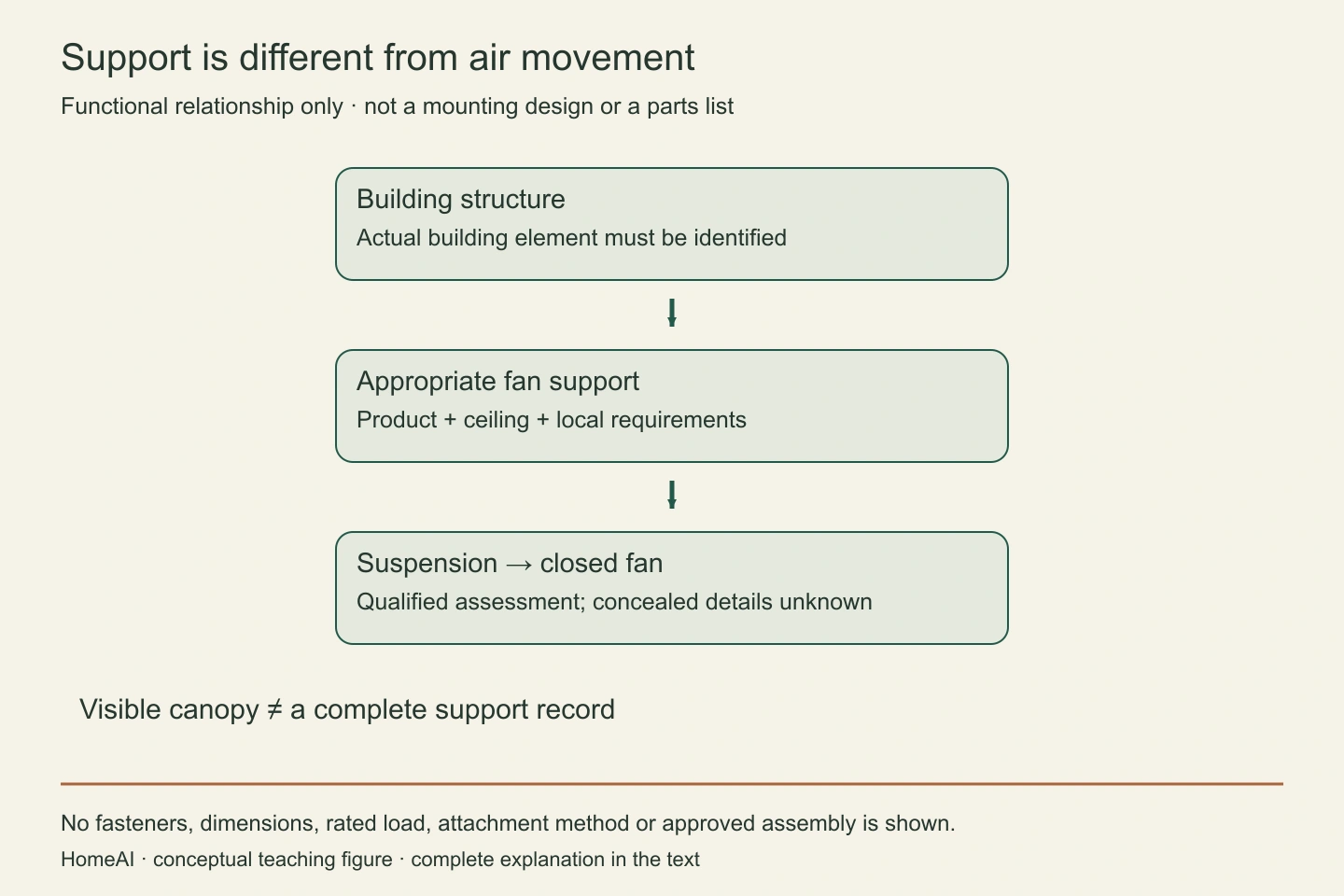
- Building structure
The actual supporting building element needs identification by the appropriate provider.
- Appropriate fan support
Its suitability belongs to the actual product and installation assessment.
- Suspension
Connects the appliance to its supporting arrangement; details are intentionally omitted.
- Closed fan
Motor and blades have an operating job distinct from attachment.
What does this illustration leave out?
Conceptual learning figure; no property measurement, approved installation or owner test. This illustration explains an idea. It is not an installation guide.
Who assessed the actual product, ceiling and supporting arrangement?
Explore this with HomeAI ↗Opens an editable question. Nothing is sent until you choose to send it.What should I do about wobble, noise or changed operation?
Record a newly noticed concern from an ordinary safe position without repeating it. Name the room, approximate date, known model, ordinary operating context and any relevant recorded work. A sound, visible movement and a light-control issue are different observations. Do not turn any of them into a diagnosis solely because a troubleshooting list names a possible cause.
Unusual oscillating movement is an explicit stop-use and qualified-help condition in the named Canarm manual. Follow the actual model’s safe instructions and keep clear of the moving assembly. Do not run a visibly suspect fan for a better video. This guide offers no balancing method, fastening check, blade bending, cover removal or internal electrical troubleshooting.
A noise concern can involve an equipment or control question, but its cause requires appropriate assessment. A quiet fan does not prove concealed support or wiring condition, and an observed hum does not independently identify a motor fault. The written assignment should state the concern and request the provider’s findings, including which functions and accessible parts were assessed.
Smoke, fire, sparks, a burning smell or water affecting electrical equipment changes the priority. Keep clear of danger; for fire or smoke, leave and call emergency services from outside. Do not touch or operate suspect wet electrical equipment. Preserve the record after the urgent response. An educational comfort comparison must never encourage continued operation of a device that needs safety attention.
What can comfort observations and product numbers establish?
A comfort report describes a person’s experience at a stated place and time. An air-temperature reading describes an instrument’s result at its location. A product airflow figure describes a rated quantity under a defined method. Keep those entries separate. A bedroom that feels better with a fan has not demonstrated a measured temperature reduction or the product’s rated airflow at the pillow.
NRCan’s administrative ceiling-fan page distinguishes airflow, efficiency and electrical-input reporting; it separately identifies light-kit information. Airflow describes an amount of air moved over time. Electrical power describes an input rate. Light output is a different quantity again. The biggest advertised number cannot rank those different jobs in one column.
Ask which exact model, operating state, units and test basis the supplier means. A regulatory listing or product mark has its own scope and does not certify the support, control pairing or installation in your home. The federal page is an administrative aid, explicitly separate from the law itself. No product approval, minimum value or manufacture-date verdict is supplied here.
For energy questions, preserve actual consumption periods, included loads and the comparison basis. Fan runtime alone is not whole-home cooling energy, and a changed thermostat setting is not an isolated saving. Weather and household use can also differ. Ask what method would answer the actual investment question; do not infer a bill reduction from a pleasant breeze or borrow a generic saving percentage.
When does the household need a wider heat plan?
Perceived comfort is not a heat-safety certificate. Health Canada’s September 2026 public guidance says fan comfort has limits in very hot conditions and recommends planning access to a cooler place. Do not use a comfortable-feeling breeze as permission to stay in unsuitable heat. Follow current local alerts and individual healthcare advice, particularly where a household member has greater vulnerability.
Heat stroke is a medical emergency. Health Canada identifies signs including confusion, lack of coordination, high body temperature and very hot or red skin. Call 911 immediately for suspected heat stroke and begin appropriate cooling while help is coming. Do not wait for a fan service visit or a longer temperature log before seeking emergency help.
For planning, identify a suitable cooler location, the practical way to reach it and the contact who can assist if needed. A ceiling fan depends on its electrical supply and only serves its intended air-moving job. A room-cooling arrangement and an alternative location need separate consideration. The broader overheating guide connects room heat gains, cooling and combined heat/smoke constraints.
This chapter deliberately supplies no new safe-temperature cutoff, medical diagnosis or assurance for a particular person. A threshold copied without its source scope can mislead, and a reading at one instrument does not represent every occupied place. Keep current public-health directions available. The owner’s useful next step is a practical household plan with appropriate advice, rather than a test of how long the fan can maintain comfort.
Choose the next step by the concern
A heat concern, suspect fan movement and a routine comfort question lead to different actions. Do not continue a suspect fan or postpone heat relief to complete a comparison.
Numbers identify the parts explained below.
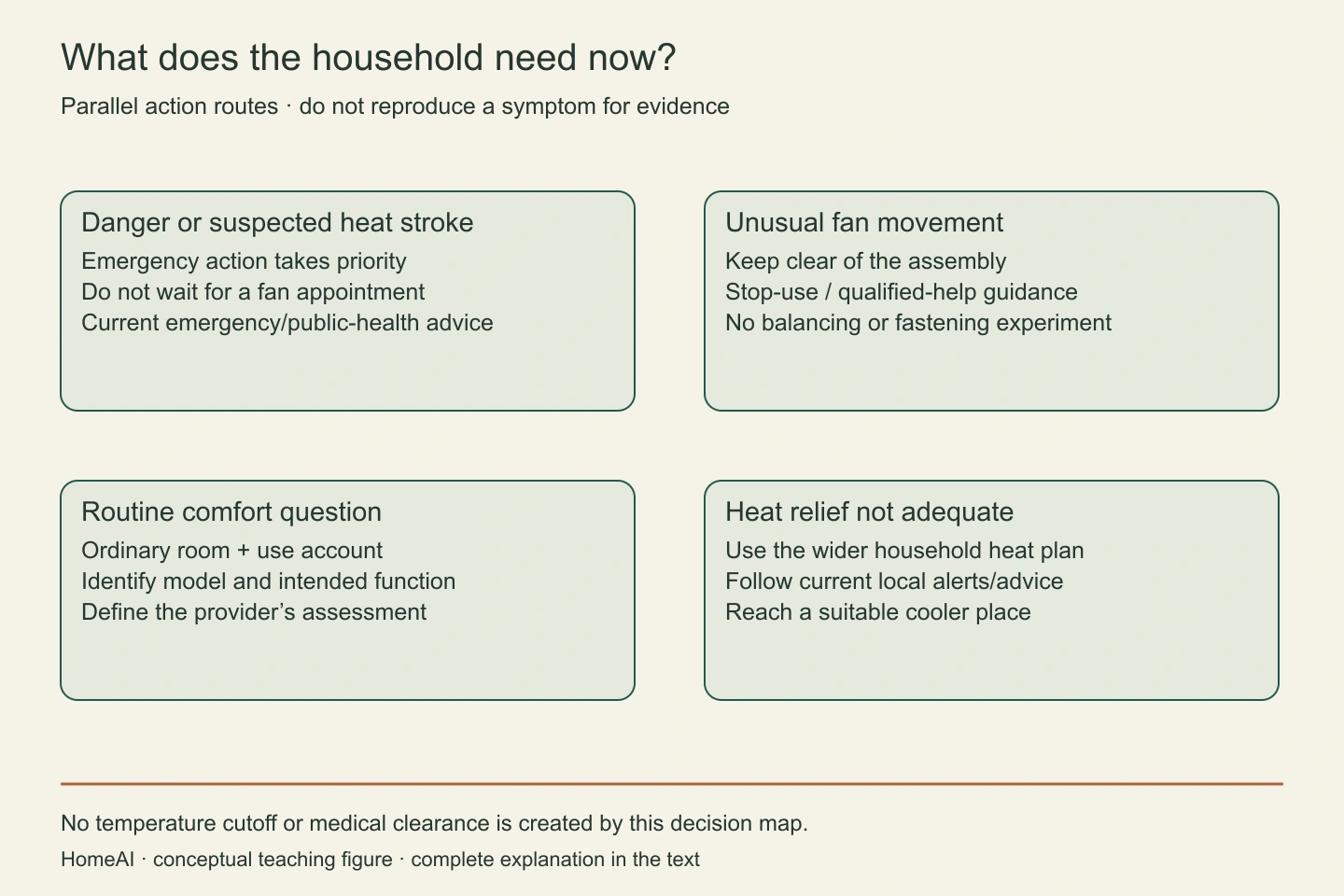
- Urgent danger
Fire/smoke or suspected heat stroke requires immediate appropriate emergency action.
- Suspect fan
Keep clear; unusual oscillation calls for stop-use and qualified help under the actual instructions.
- Routine comfort
Record ordinary context and ask which air-moving or cooling job is needed.
- Wider heat plan
Use current local health directions and a practical cooler-place plan.
What does this illustration leave out?
Conceptual learning figure; no property measurement, approved installation or owner test. This illustration explains an idea. It is not an installation guide.
Is this urgent safety, equipment assessment or routine comfort planning?
Explore this with HomeAI ↗Opens an editable question. Nothing is sent until you choose to send it.Who should explain a replacement or installation proposal?
Begin with the desired job and room: ordinary comfort where people sit or sleep, lighting needs, available controls and any existing concern. Ask the provider which equipment is proposed and how it suits the actual room and ceiling. A replacement should address an identified purpose or finding, rather than assuming a larger blade span solves every comfort complaint.
Request a scope covering relevant product/control compatibility, support, building context, electrical work, required authorizations and completion evidence. The appropriate qualifications and authority process depend on location and work. In Ontario, ESA says hired home electrical work must be done by a Licensed Electrical Contractor and distinguishes electrical notification from a building permit. Those titles and processes are Ontario examples, not a national rule.
ESA also explains that its review process can vary with risk; a completed record should be read with its actual scope. Ask the relevant local authority and provider what applies at the address and which final documents should be retained. A general statement that the device is approved cannot replace identification of the work and its record.
If support or surrounding construction needs a different specialist, assign that responsibility clearly. Ask who restores affected finishes and who explains ordinary operation and future care. A HAUSE referral or AI guide does not establish anyone’s licence, assessment finding or availability. Confirm actual qualifications and scope with the provider. The contractor-management guide helps carry the agreed proposal through changes and completion.
Fictional example: does a working light clear a noisy fan?
This is an explicitly fictional household. Eli has an existing bedroom fan with an integrated light and a remote. The light works, while a new noise was noticed during ordinary fan use. An older invoice says ceiling fixture installed but gives no fan or control model and no support description. The available account does not establish which function was checked or why the noise occurred.
Eli keeps clear of the appliance and contacts an appropriately qualified provider instead of reproducing the noise. The existing invoice, remote instructions and ordinary-use description are supplied. The provider is asked to identify the actual equipment and define whether the concern calls for motor/control, support or wider electrical assessment. The story does not choose a fault from the sound.
Suppose a later fictional report identifies the model and describes one assessed control issue, while excluding concealed building support from its scope. Eli retains both statements. A repaired control would remain its own completed task; it would not silently become a support clearance. Any remaining relevant question needs the appropriate agreed follow-up, without assuming every unknown is defective.
The example includes no measured airflow, temperature, approved control pair, cost or promised repair result. Its useful outcome is a functional record: fan movement, lighting, controls and support are separate questions with named evidence. Eli’s wider heat plan stays independent of the repair. A functioning lamp and a pleasant room impression cannot answer all the questions about the rotating appliance above it.
What should the fan handover and care file contain?
Keep the actual fan and control identities, matching manual edition, any separately documented light parts, installation date and original work account. Add the provider’s explanation of ordinary functions, safe fault response and care responsibilities. A manual for a visually similar fan is not enough. If a product is later replaced, preserve the old chronology and create a new identified entry.
Keep installation and assessment records distinct. The former describes completed work; the latter describes observations, methods, findings and exclusions. Relevant authority records have their own project scope. Ask what ordinary functions were demonstrated and which concerns remain. No successful handover can guarantee every future condition, and one working mode does not establish all other modes.
Use existing documents and safe ordinary observations to fill gaps. Do not climb for an inaccessible label, dismantle the light, remove the canopy or check fasteners to complete the file. Have the provider supply identities and explain the actual maintenance instructions. This guide offers no universal cleaning, inspection, replacement or balancing schedule.
A clear final account should be simple enough for another household to use: the motor turns these blades to move room air, these controls request the documented functions, the light is a separate job, the support has its own assessed scope, and these people handle service. Keep the wider heating, cooling and ventilation guides connected. The next useful action is to send an unanswered specific question to the responsible provider, not treat air movement as evidence that the entire room or installation has passed.
Keep learning about the connected parts
- Understand why a home holds summer heat
- Window and portable air conditioners: follow the heat out of the room
- Switches, dimmers and LEDs: understand what controls your lights
- Why one room won’t warm up
- Electrical renovation records: what was actually checked?
Canadian context and authorities · Visual atlas · Learning labs
Practice the distinction.
Eli’s fictional working light and noisy fan
An invented bedroom light works while a new fan noise is reported; the old invoice lacks product and support details.
Reported observations
- The light operated during ordinary use.
- A new noise was already noticed, without a repeated test.
- The old work record does not identify support scope.
Compare the explanations
Expand each possibility to see the evidence needed to distinguish it. Similar symptoms can have different mechanisms.
An equipment or control issue needs assessment
The sound does not identify a failed part.
Exact identities and qualified findings.
Support remains a separate scope
A control assessment may exclude concealed attachment.
Appropriate agreed support/building assessment when relevant.
A useful next question
Contact a qualified provider with existing documents and the ordinary-use account; retain findings and exclusions separately.
No actual fault, approved pairing, cost, measured comfort or repair outcome is represented.
Know what the words mean.
- Ceiling fan
- A suspended appliance whose rotating blades circulate air; it is different from a ducted exhaust fan.
- Motor
- The part providing rotation to the fan assembly. Turning blades do not independently establish every other function.
- Canopy
- The cover near the ceiling; its appearance does not reveal or approve concealed support.
- Light kit
- The lighting function integrated with or documented for a fan. Its control requirements need their own product information.
- Recirculation
- Movement of air within the space, without by itself establishing outdoor-air exchange.
- Comfort observation
- A person’s dated experience at a stated location, different from an instrument result or heat-safety finding.
Questions to bring
to the conversation.
- Which exact fan, control and manual are identified?
- What ordinary concern was already noticed, without reproducing it?
- Who will assess the relevant equipment, support and electrical scope?
- What wider cooler-place plan applies when fan comfort is insufficient?
Separate a showing observation, an existing record and a new professional assessment. Unknown means a question remains; it does not automatically mean a defect.
Use the evidence planner ↗Go to the source.
Original HomeAI explanation informed by these public references. Sources support the underlying guidance; they have not reviewed or endorsed HomeAI. Diagrams are conceptual, and calculator outputs depend on your inputs.
Sources were read October 15, 2026. Federal education, current Health Canada public advice, Québec utility guidance, the named Canarm multi-model manual and Ontario ESA guidance have different scopes. The manufacturer original PDF could not be retained; its complete seven-page web extraction was read. No product approval, installation specification, medical clearance or actual household finding is established. The worked household is fictional and illustrations are conceptual.
Publication & source review
First published .
Sources reviewed .
- Natural Resources Canada · How to stay cool all summer
- Natural Resources Canada · Ceiling fans and ceiling fan light kits
- Hydro-Québec · Tips on air conditioning
- Health Canada · Extreme heat events: How to protect yourself from the health effects of extreme heat
- Canarm · Dual Mount Series installation instructions CF-5E
- Electrical Safety Authority · Notifications and Inspections
Have a question about your home?
Start with the symptom, timing and what you have observed.
Ask HomeAI